satisfactory-dash
- React
- TypeScript
- Express
- Vite
- Zod
- PostgreSQL
- AWS S3
- pino
- Docker
The problem
Satisfactory players who run a dedicated server can't see their factory's state without joining the game. The data exists in two places, the game's own HTTPS API and a community mod (FRM) that exposes factory and power data. Both are undocumented in the places that matter (units, sign conventions, what "0" means), and FRM speaks only plain HTTP. So the project had two problems: getting correct data out, and never exposing the game server itself to the internet.
See it running
The live demo runs the real dashboard against a made-up factory, with no sign-in and no connection to the real API. This is a one-minute tour of it.
Text description of this video
The recording starts on the demo's entry screen, which explains that the factory is made up and needs no sign-in, and clicks Enter demo. The Overview page shows all systems operational: a server with 3 of 4 players connected, two power circuits drawing 4,232.5 MW of 6,150 MW capacity, and 9 factory machines with 1 backed up. The Power tab shows each circuit's production, consumption, capacity, peak demand and battery state, with a chart of the last five minutes. The Factory tab lists every machine with its recipe and output rate, and marks a Rotor assembler as backed up. The Settings tab ticks the auto-pause option, and the page shows the change as pending until the server applies it. The tour ends back on the Overview page. A banner across the top of every screen says the data is not live.
Architecture
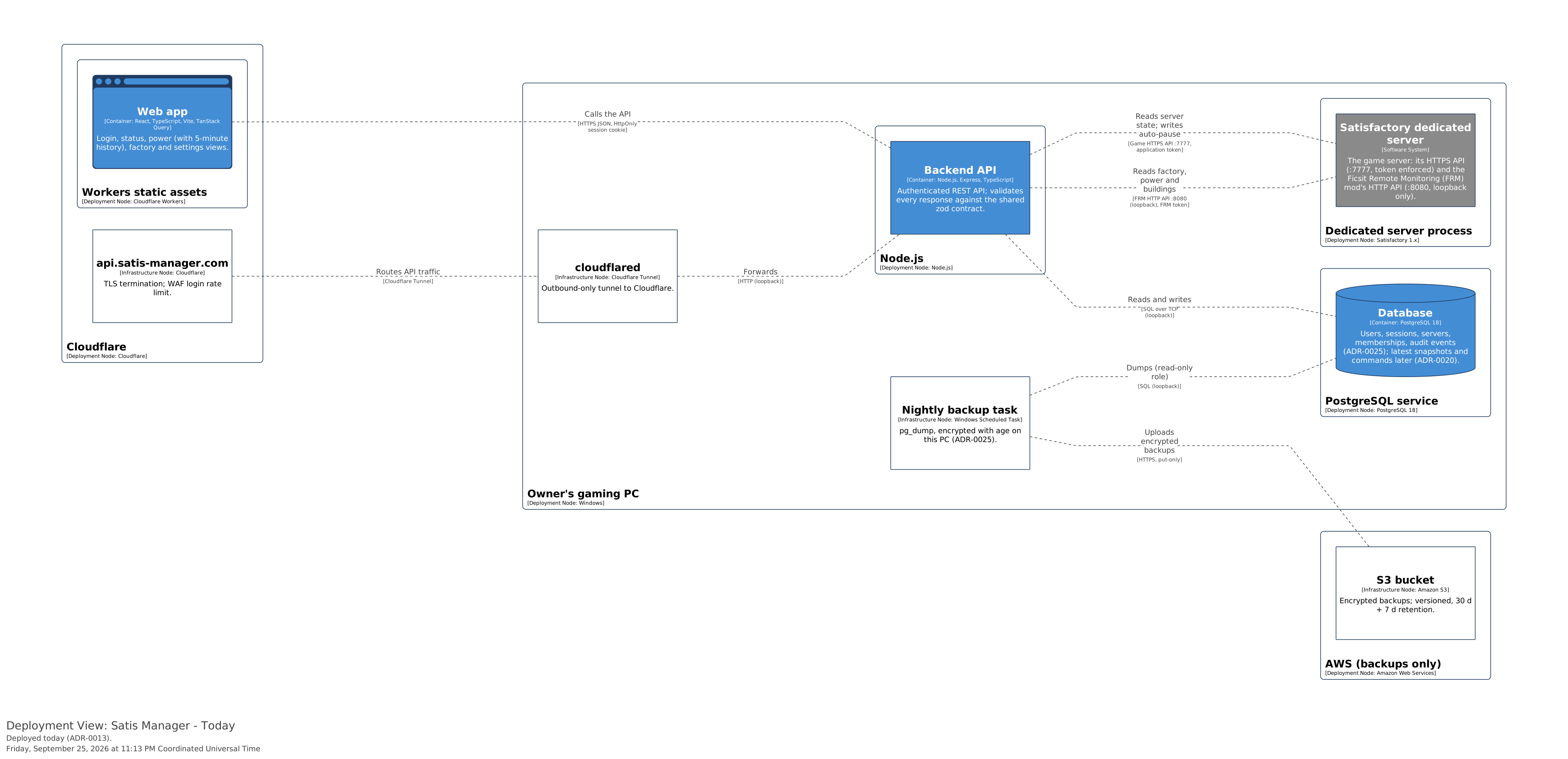
Text description of this diagram
The browser reaches the web app, served as static assets from Cloudflare Workers, over HTTPS. The web app calls api.satis-manager.com, which terminates TLS and enforces a WAF login rate limit, then routes traffic through an outbound-only Cloudflare Tunnel to cloudflared, running on the owner's gaming PC. cloudflared forwards over loopback HTTP to the backend API (Node.js, Express, TypeScript), which authenticates every request and validates every response against the shared zod contract. The backend reads and writes the Satisfactory dedicated server's HTTPS API (port 7777, application token) to read server state and toggle auto-pause, and reads the Ficsit Remote Monitoring (FRM) mod's HTTP API (port 8080, loopback only) for factory, power, and building data. The backend keeps users, sessions, servers, memberships and audit events in the Database container, a PostgreSQL 18 service on the same PC. A nightly scheduled task on that PC runs pg_dump, encrypts the dump with age, and uploads it to an S3 bucket in the AWS node, which is used for backups only; the bucket is versioned and expires copies after 30 days plus 7 days of version retention.
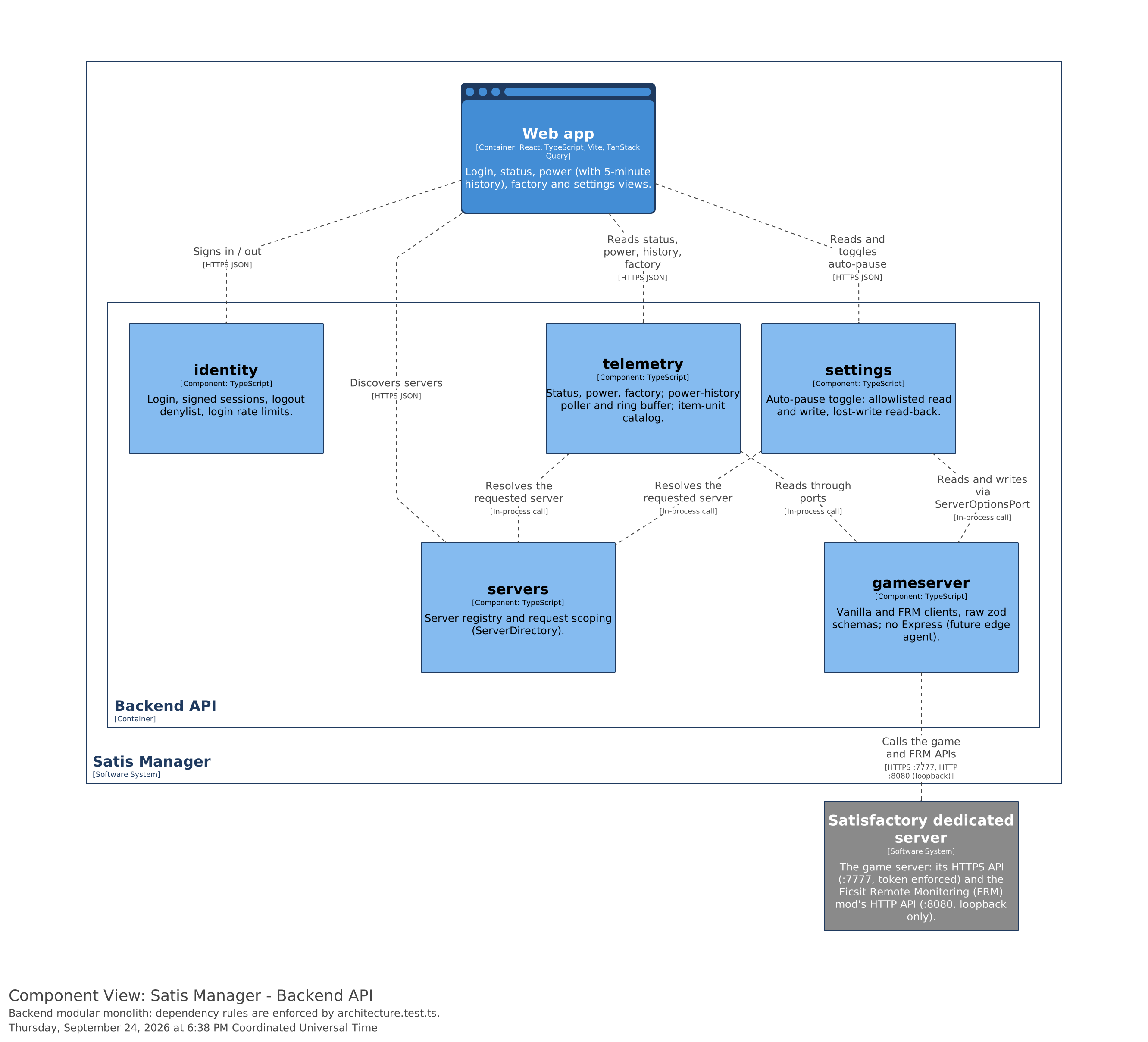
Text description of this diagram
The backend is a modular monolith of five components, and a CI test checks these dependency boundaries against the real imports. The web app signs in and out through identity, which manages sessions, a logout denylist, and login rate limits. It discovers available servers through servers, the server registry. It reads status, power history, and factory data through telemetry, and reads and toggles auto-pause through settings — both telemetry and settings first resolve the requested server through servers. Neither talks to the game directly: only gameserver calls the Satisfactory dedicated server's HTTPS API (port 7777) and the FRM mod's HTTP API (port 8080, loopback), through vanilla and FRM clients built on shared zod schemas.
These diagrams aren't hand-drawn — they're rendered from a C4 model (Structurizr DSL) that CI validates on every change, with an ADR recording each decision.
The frontend is a React single-page app served as static assets from Cloudflare. The backend runs on the same PC as the game server and talks to it only over loopback. It refuses to start if pointed at a public FRM host. Public access to the API goes through an outbound-only Cloudflare Tunnel, so no router ports are opened. As of 2026-09-24 the tunnel is live end to end: the site signs in against the real API and shows live game data, and it passed go-live tests for CORS, security headers, IP-spoofing resistance, and the login rate limit. Frontend and backend share one runtime-validated contract package.
Key decisions
- Server-scoped routes before a second server exists. Every data route is
/api/servers/:serverId/..., and a single server is a "registry of one". Adding a second server becomes a configuration change instead of a rewrite of every URL the frontend knows. Trade-offOne extra indirection and an id in every request, today. - A zod contract as the single source of truth. Types are inferred from runtime
schemas in
packages/shared. The frontend parses every response, and the backend validates every response it sends and transmits only the parsed output. Drift fails in CI or loudly at runtime, never silently in the UI, and an accidental internal field can't leak. Trade-offA little CPU per response. - A snapshot envelope with staleness. Every data response is
{ serverId, observedAt, stale, data }, and the backend decidesstale. Moving from live calls to a background poller later needs no frontend change. Trade-offA wrapper around data that is always fresh today. - Units verified against the live game. Units and sign conventions were checked
against a populated save and the in-game UI before being written into field names
(
productionMW,batteryCapacityMWh). The captures also exposed a real mapping bug: the "backed up" detector required a machine to still be producing, so it never fired — 0 of 71 backed-up machines were detected on the captured save before the fix. Trade-offRenames were done early, while there were no consumers yet. - Login before exposure. Every API route except health needs an httpOnly session cookie. Login is rate-limited per client, and cross-site mutations are refused. The repository and frontend are public; the API must not be. Sessions started as stateless signed tokens and are now server-side in Postgres: the cookie holds a random 32-byte id, the table stores only its SHA-256, every login gets a new id, and a session can be revoked for real. Trade-offEvery authenticated request needs a database lookup, so a database outage answers 503, never 401: an outage must not look like being signed out.
- No database and no cache until a trigger fires. Requests go straight to the game server. That was measured before deciding against caching: about 25 ms for the factory call, well under the 463 KB raw upstream payload it's built from. Postgres was pre-decided for when history or user accounts were needed, and accounts have since brought it in. Trade-offGame-server load grows with viewers until then.
- PostgreSQL 18 with hand-written SQL and least-privilege roles. The database runs on the
game PC beside the backend. SQL is hand-written and parameterized, every row set is parsed by a
zod schema, and correctness lives in single statements and constraints: a partial unique index
allows one owner per server, and a guarded
DELETE ... RETURNINGmakes a login attempt single-use. Migrations are forward-only (node-pg-migrate) and run as an explicit step, never at startup. A migrator role owns the schema, the app role gets only the reads and writes it needs, and a read-only role exists for backups. Database tests run against a real Postgres in CI. Trade-offNo query builder means no compile-time column checks: a mistyped column fails the integration tests instead. The ADR names the trigger for revisiting it, the first query that needs runtime composition. - An audit trail the app cannot rewrite. Sign-ins, sign-outs and membership changes write audit
rows that carry ids, never emails or tokens. The app role can insert rows but not update, delete
or truncate them, and it cannot set the timestamp, so no row can be back-dated (and purged
early) or future-dated (and never purged). The one-year retention is enforced by a narrow
SECURITY DEFINERfunction that deletes only older events and leaves a count-only trace row. Trade-offASECURITY DEFINERfunction runs with its owner's rights, so it has to stay narrow: a pinned search path, schema-qualified names, and EXECUTE granted to the app role only. - Sign-in with Google, keyed on the account, not the email. The OpenID Connect flow uses
openid-clientand checks state, nonce and PKCE. An account is found by Google's subject id, never by email, and sign-up is closed: an account that isn't already invited is refused and nothing about it is stored. Failures redirect to the login screen with a fixed error code, never a JSON body, and the one-time callback parameters are kept out of the request log. It was security-reviewed, and the review's low-severity findings were fixed. Trade-offIt is implemented but not open to the public: the Google app stays in testing until the owner's go-live gate passes. - Player names, and nothing else. The Players card shows who is online from the game's own monitoring data. The raw schema declares only a name and an online flag, so ids, locations, health, speed and inventory are dropped at the boundary before the rest of the code sees them, and the route is limited to members of that server. The privacy page has a row for it. The card shows all 12 player slots, beside a Health card that shows the server's tick.
- Managing several servers, with the credentials encrypted and the network path guarded. Servers now live in Postgres instead of a config file. Each server's API and FRM tokens are sealed with AES-256-GCM, a random nonce per value and a stored key id so the key can be rotated. The API never returns them, only "set" and the last four characters, and they are never logged. Only the operator can add, edit or remove a server. Because the backend now connects to addresses someone typed in, it is an SSRF surface, so every address a hostname resolves to must be allowed, the client never follows a redirect (which would carry the token to wherever it points), and non-loopback (LAN) addresses are refused in code until certificate pinning exists. A combined security review of the whole phase ran before it shipped and led to two fixes. Trade-offRefusing LAN addresses until pinning exists means a server on another machine in the house can't be added yet, and other people's servers wait for the edge agent instead of the backend calling them.
- Production history in SQL, with rollups and retention. The backend records power and
per-item production into Postgres. Raw samples are kept for 48 hours, then folded into
one-minute rollups (kept 30 days) and one-hour rollups (kept a year) by an idempotent
INSERT ... ON CONFLICT DO UPDATEjob, with retention as batched deletes. Nothing is recorded while the game is paused, because the monitoring mod returns frozen values then. A history API picks the resolution from the range asked for. Trade-offOne server produces a few hundred thousand raw rows a day, so the short raw window and rollups keep the database small at the cost of fine detail beyond two days.
How it's built
- Contract-first sequencing. The shared contract merged before the backend or frontend consumed it, and each breaking change was staged in its own PR. The frontend was built against mocked responses generated from the same fixtures the backend tests use.
- Independent bug hunts. A reviewer with no context from the implementation hunts for bugs
in each change. Examples:
- In the auto-pause toggle it found that a rapid double click sent two writes to the game server.
- A retroactive sweep of the frontend added 30 tests and fixed 2 bugs, each proven by a test that failed before the fix.
- Security reviews gate exposure. The login work had a dedicated security review, whose low-severity findings were fixed before any public exposure. The findings covered cross-site logout, a password-hash parameter bound, and usernames in logs. The tunnel checklist included a test proving spoofed client-IP headers aren't trusted.
- CI and required checks. Every PR runs lint, typecheck, tests and a production build. A
ruleset on
mainrequires that job to pass before merging; a separate practice (not CI-enforced) runs an independent test-hunter subagent over any PR that changes real logic before it's marked ready for review. - A leak check that proved itself. CI scans every change for personal identifiers and local paths. The scan's patterns were later moved into a repository variable, so the public workflow no longer lists what it protects, and a hit reports only file and line.
- A merge queue with a review gate that fails closed. Merges to
maingo through a GitHub merge queue, and a custom workflow only lets a change through if an independent fresh-eyes review has passed on that exact commit; anything it can't identify is refused. Its first real run was dropped because the gate itself misread the queue's full branch ref, so the fix parses it strictly and keeps failing closed on anything else, with tests using the real value. Each PR also adds its own log fragment, enforced in CI, which ended merge conflicts in the shared log. Work is tracked on a GitHub Projects board against a written roadmap with measurable targets. - Encrypted backups, off the machine. A nightly job runs
pg_dump, encrypts the dump withageto a public key (the private key stays offline, so neither the PC nor a leaked AWS key can read old backups), and uploads it to a versioned S3 bucket in the owner's own AWS account through a put-only IAM identity that can't read, list or delete. A lifecycle rule expires copies after 30 days (up to 37 with versioning), a Better Stack heartbeat alerts when a night is missed, and a retry wrapper handles a dropped connection. It is proven end to end: the first real nightly run succeeded, and a restore rehearsal passed. The newest S3 object was decrypted with the offline key and restored into a scratch database, and the row counts matched the live database (the one audit event that differed was newer than the dump). - A root-cause hunt, written down. After a restart, the backend's first database connects to
127.0.0.1failed withETIMEDOUTand never reached Postgres. The first hypothesis, Windows Defender, was tested and excluded. A kernel TCP/IP trace (netsh trace) showed the server sending the SYN-ACK on loopback and the client never receiving it. Node on Windows doesn't retransmit a loopback SYN, so one lost packet became a timeout at about 310 ms. The loopback filter of Npcap, the packet-capture driver that ships with Wireshark, was dropping it: 34 of 40 connects failed with it running and 40 of 40 succeeded with its service stopped. Setting the service to manual start fixed it (20 of 20 afterwards), and a startup-ordering change stays as defence in depth. - Decisions are recorded. Thirty-one architecture decision records document context, trade-offs and the specific trigger that would reopen each one.
What's next
- Alerts to Discord, built on the recorded history, are in progress.
- A live factory map with buildings at their in-game positions, which FRM already reports.
- Opening sign-in to more people. Google sign-in is implemented and reviewed but not yet public. Before it goes live the owner tests it end to end and revoke-all is tested; the backup restore rehearsal has already passed. Sign-up then opens to invited emails only, not to anyone with a Google account.
- Multiple users and AWS. The planned path is a modular monolith now, then a few coarse services, with a small agent next to each game server pushing data outbound. That removes any need to reach into a user's network. The API and database move to AWS only when managed hosting is needed; the backup upload to S3 is the only AWS piece so far.